


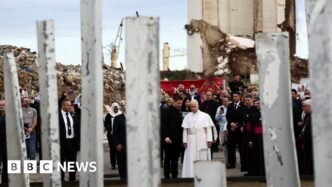

Pope Leo XIV performed a silent prayer at the site of the Beirut port explosion and demanded justice for its victims, at the end of his three-day visit to Lebanon.
He also met some relatives of the 218 people killed in the massive explosion on August 4, 2020, which destroyed a large part of the capital.
Later, the Pope said he was “deeply moved” by his visit to the port and shared “the thirst of many families and an entire country for truth and justice.”
No one has yet been held accountable for the disaster that occurred when a fire exploded 2,750 tons of ammonium nitrate that had been unsafely stored in a port warehouse for nearly six years.
It is widely believed that officials and politicians were aware of the presence of the combustible chemical and the danger it posed, but failed to secure, remove or destroy it.
Relatives of the victims and activists say that local investigations into the disaster have been hampered by the efforts of the political leadership to protect those responsible for the investigation.
Cécile Roques, whose brother Youssef was killed, said the pope’s visit to the memorial was “very important.” She added: “We know that he is raising his voice for justice, and we need justice for our brothers and for all the victims of this explosion.”
Tatiana Hasrouti, who lost her father Ghassan in the explosion, said: “He is trying to help us find the truth somehow, in his way, maybe by praying and maybe by just looking at us… We, the families, now, after five years, need people to look at us.”
After praying at the site of the explosion, the Pope celebrated the final Mass of his trip in front of an estimated 150,000 people gathered on the Beirut waterfront.
In his speech to the audience, he expressed his regret that the beauty of Lebanon was “overshadowed by poverty and suffering, which are the wounds that marked your history.”
But he appealed to the country’s diverse communities to unite to solve their problems.
He said: “Let us remove the shield of our ethnic and political divisions, open our religious sects to mutual encounter, and awaken in our hearts the dream of a unified Lebanon.” “Lebanon is peaceful and just, where everyone recognizes each other as brothers and sisters.”
Since the last papal visit in 2012, the small country has been plagued by multiple crises.
In 2019, the country suffered one of the worst economic recessions recorded in modern times, pushing millions into poverty.
It was followed by massive anti-government protests, the coronavirus pandemic, and then the Beirut port explosion.
Political paralysis prevented the country from adopting the economic and structural reforms demanded by foreign donors in exchange for billions of dollars in aid.
Lebanon was later devastated by the 13-month war between the Shiite Hezbollah movement and Israel, which resulted in the deaths of 4,000 Lebanese and 120 Israelis.
A ceasefire ended the conflict a year ago, but Israel has continued to attack targets it says are linked to Hezbollah, and has accused the Iran-backed group of trying to rearm.
https://ichef.bbci.co.uk/news/1024/branded_news/423b/live/406c44d0-cf86-11f0-8c06-f5d460985095.jpg
2025-12-02 14:25:00