


Natasha swag,
imogen Foulkes,Geneva correspondent and
Barbara Plett Asher,Africa correspondent

 AFP via Getty Images
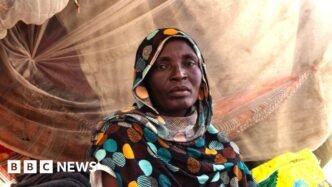
The UN Human Rights Council unanimously approved a new independent investigation into the mass killings that took place in the Sudanese city of El Fasher.
“Our wake-up calls have not been heeded,” Volker Türk, the UN High Commissioner for Human Rights, said during an emergency meeting in Geneva on Friday. “The bloodstains on the ground in El Fasher have been photographed from space. The stigma on the international community’s record is less visible, but no less damaging.”
Since the civil war began more than two years ago, more than 150,000 people have been killed and about 12 million forced from their homes.
The new investigation aims to determine the identity of those who ordered and carried out the El Fasher massacre.
The results can be shared with the International Criminal Court.
While Turk warned individuals and companies against “fueling and profiting from the war in Sudan,” there was disappointment that the mandate did not mention other countries sponsoring the conflict.
The UAE is accused of shipping weapons to the paramilitary Rapid Support Forces, while Iran is accused of supplying some weapons to the Sudanese army.
In addition, there is concern that the cash-strapped UN, which is already finding it difficult to continue its humanitarian work in Sudan, may not have the funds to conduct a truly credible investigation.
The Rapid Support Forces took control of the city of El Fasher last month after an 18-month siege. It was the last city in Darfur controlled by the army and its allies.
The RSF has been accused of targeting non-Arab groups in the city and elsewhere in Darfur, which the RSF has denied.
One horrific feature of this conflict is the huge volume of footage and photographs of horrific atrocities – often filmed by the perpetrators themselves, and circulated online. Researchers say this digital evidence will be analyzed in an attempt to bring the perpetrators to justice.
“The people of Sudan, especially now in El Fasher, are facing a situation I have never seen before,” says Mona Rishmawi, a member of the UN fact-finding mission on Sudan who has witnessed the change firsthand for more than two decades.
She told the BBC’s Newsday program that the scale of suffering today in Darfur is greater than the genocide committed by the Janjaweed militia in the same region 20 years ago. The origins of the Rapid Support Forces go back to the Janjaweed.
Ms. Rishmawi explained that at the time, attacks mainly targeted villages, but now paramilitary forces target entire cities and refugee camps housing hundreds of thousands of people.
“[There have been] She added: “The devastating mass killings, rape, torture, disappearances and missing persons come against the backdrop of 18 months of siege and famine.”
A joint G7 statement earlier this week condemned the escalation of violence in Sudan, saying the conflict between the army and the Rapid Support Forces sparked “the largest humanitarian crisis in the world.”
It comes after the Trump administration’s most visible intervention yet in Sudan’s civil war, with Secretary of State Marco Rubio calling at the G7 summit for international action to stop supplying weapons to the RSF’s paramilitary forces – as well as harsh criticism of some countries.
The United States is one of the so-called “Quad” countries working to end the crisis, along with the United Arab Emirates, along with Egypt and Saudi Arabia, which are allies of the military-led Sudanese government. The bloc recently proposed a three-month humanitarian truce, followed by a permanent ceasefire and a nine-month transition to civilian rule.
“We know who the parties involved are,” Rubio, in what was widely seen as a reference to the UAE’s alleged support for Sudanese rebels, said on Wednesday. [in weapons supply]… That is why they are part of the Quad along with the other countries involved.”
The UAE, which has long denied supporting the RSF, responded in a statement on Thursday, saying it was concerned about the “heinous attacks launched by the RSF against civilians in El Fasher” and accused the Sudanese army of “starvation tactics, indiscriminate bombing of populated areas and the alleged use of chemical weapons.” These are accusations that were previously rejected by the Sudanese army.
There was also an angry denial from the Rapid Support Forces, denouncing what it called “all tendentious statements against it” and attempts to make it a scapegoat to cover up the army’s rejection of the truce.
The Rapid Support Forces waited until they took control of El Fasher before announcing their approval of the truce. The Sudanese army says it objects to the presence of the UAE in the Quartet, but will continue to study the proposal.
Meanwhile, there was no let up in the fighting.
Only a small portion of the population was able to flee El Fasher, where the massacres are said to have taken place. Piles of bodies on the ground and blood-stained ground It can be seen from space in satellite images.
Speaking on Friday, Turk said: “There has been a lot of demonstration and performance, and there has been little action” by the international community in the face of Sudan’s devastating civil war.
“You must stand up to these atrocities – a display of blatant cruelty used to subjugate and control an entire people.”
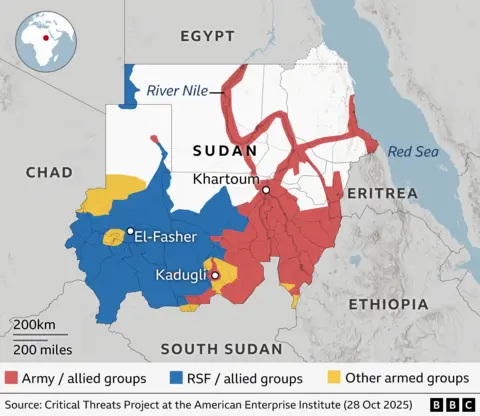
The flow of weapons into Sudan during this war has been analyzed by many experts.
Amnesty International says it has found evidence of weapons manufactured in Serbia, Russia, China, Turkey, Yemen and the United Arab Emirates being used in Sudan.
The smuggling route is often through the United Arab Emirates, through Chad, and then to Darfur. According to a leaked report by United Nations experts.
The UAE in particular is accused of providing weapons and support to the Rapid Support Forces, which in turn is accused of using the UAE as a market to sell illicit gold.
On Wednesday, Rubio said clearly that aid to the RSF “doesn’t just come from a country that pays for it, it also comes from countries that allow their territory to be used to ship and transport it.”
He also said he did not want to “minimize” the involvement of other actors in the conflict, saying “that would probably include the Iranians, at least the money and weapons being flown to the other side,” referring to the Sudanese military.
All parties deny these accusations.
Two weeks ago, the UK government came under fire from lawmakers following allegations that British-made weapons were ending up in the hands of the Rapid Support Forces, which were using them to commit atrocities.
In response to an MP’s request to “halt all arms shipments to the UAE until it is proven that the UAE is not arming the RSF”, Foreign Secretary Yvette Cooper said at the time: “The UK has very strong controls on arms exports, including preventing any diversion. We will continue to take that seriously.”
The United Nations has imposed an arms embargo on the RSF stronghold in Darfur since 2004, but it has not been extended to include the rest of the country despite calls from human rights groups.
Additional reporting by Tom Pittman
More BBC stories on the Sudan crisis:
 Getty Images/BBC
https://ichef.bbci.co.uk/news/1024/branded_news/fd54/live/81b24aa0-c182-11f0-be56-f12785bd2327.jpg
2025-11-14 17:24:00