


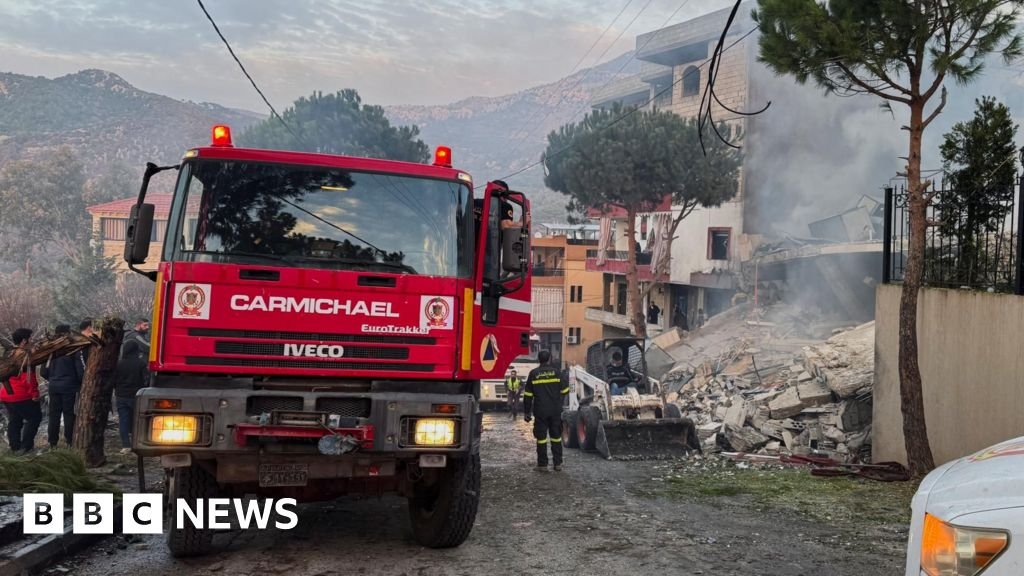
The Israeli army carried out a new round of air strikes in southern Lebanon, less than a day after Israel and Lebanon held their first direct talks in decades.
Residents of the towns of Majadla, Barashit, Jbaa, and Al-Maharuna were asked to evacuate the areas surrounding the sites that the Israeli army claimed were weapons depots belonging to the Iran-backed group. No injuries were reported.
An Israeli military spokesman said the sites constituted a violation of the ceasefire and warned that it would continue to work to “remove any threat” to Israel.
Israel has carried out almost daily strikes on Lebanon since the ceasefire came into effect in November 2024, after 13 months of conflict.
There was no immediate comment from Lebanese leaders on Thursday’s strikes. Lebanese politicians have previously condemned similar strikes, describing them as ceasefire violations.
Under the first phase of the agreement brokered by the United States and France, Israeli forces were to withdraw from southern Lebanon, while Hezbollah was to move its fighters and weapons from south of the Litani River, about 30 kilometers (20 miles) from the border with Israel — a plan opposed by the group and its allies.
Israel maintained its positions in several strategic border sites and intensified its air strikes in recent weeks. Officials say this escalation is driven by Hezbollah’s attempts to rebuild its military infrastructure and what they see as limited efforts by the Lebanese government to disarm the group.
Thursday’s strikes came less than 24 hours after Israel and Lebanon sent civilian envoys to the Lebanese border town of Naqoura to hold their first direct talks in decades.
The talks, hosted by the headquarters of the UN peacekeeping mission, UNIFIL, took place during a meeting of the Ceasefire Monitoring Committee, which until now included only military officers from the United States, France, Lebanon, Israel and UNIFIL.
Israeli Prime Minister Benjamin Netanyahu’s office issued a statement in which he said that the meeting “took place in a good atmosphere” and that “it was agreed to formulate ideas to enhance potential economic cooperation between Israel and Lebanon.”
She added that the Israeli envoys “made clear that disarming Hezbollah is mandatory, regardless of the progress of economic cooperation.”
Lebanese Prime Minister Nawaf Salam was more cautious, saying that Lebanon was still “far” from diplomatic normalization with Israel and that the talks were focused on “defusing tension.”
“We have not yet entered into peace talks,” he told reporters, adding that Lebanon’s priorities are to stop hostilities, release Lebanese detainees held by Israel, and Israel’s complete withdrawal from its territory.
He added that Beirut is open to deploying French and American forces to help verify efforts to disarm Hezbollah.
The recent strikes and diplomatic moves coincide with a visit by a delegation from the UN Security Council to Lebanon to review the stalled implementation of the ceasefire.
https://ichef.bbci.co.uk/news/1024/branded_news/83c0/live/2436af30-d139-11f0-a892-01d657345866.jpg
2025-12-04 19:47:00