


Yolande KnellMiddle East correspondent, Bethlehem

 Environmental Protection Agency
For two years during the Gaza War, all public Christmas celebrations were canceled in Bethlehem in the occupied West Bank – where Christians believe Jesus was born.
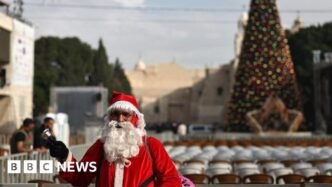
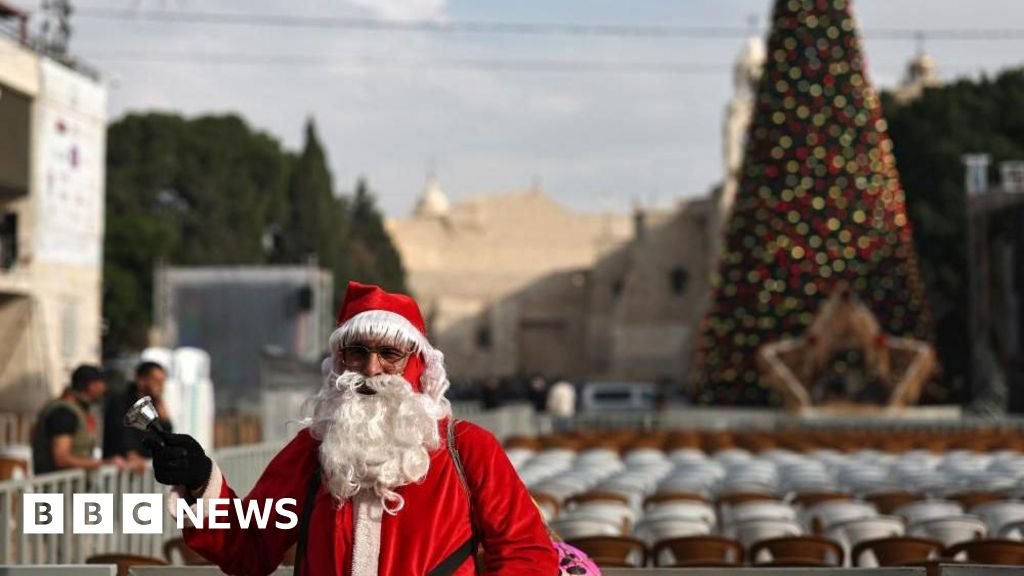
But after the recent ceasefire, the Holy City decided to return to the celebrations this year by lighting the giant traditional Christmas tree in front of the historic Church of the Nativity.
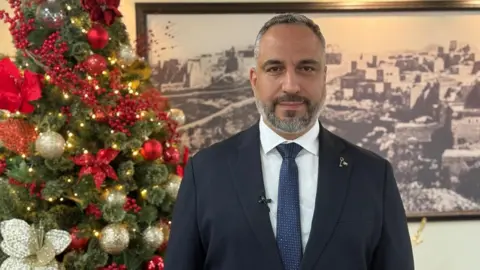
“It’s been two bad years of silence; no Christmas, no jobs, no work,” says Bethlehem Mayor Maher Kanawati. “We all live here off tourism, and tourism has dropped to zero.”
The mayor accepts that the idea of resuming celebrations was not without controversy, as suffering continues in Gaza – including those in its small Christian community, many of whom have relatives in Bethlehem.
“Some might say this is inappropriate, others say it is appropriate,” Kanawati tells me. “But deep in my heart, I felt it was the right thing to do because Christmas should never be stopped or cancelled. This is a light of hope for us.”
Locals – Christians and Muslims alike – take selfies in front of the tree hung with red and gold ornaments in Manger Square. A few foreign tourists joined them.
The streets are now decorated with brightly colored lights, and there are signs advertising Christmas markets and children’s parties.
Local jewelry designer Nadia Hazboun says: “We are very happy to have the tree, first of all, to see foreigners in Bethlehem, and to be able to celebrate Christmas in its true spirit.”
“This is where it all started, so this is where we can send a message to the world about what Christmas should really be like. And this year, if it’s a peaceful Christmas, I hope it will bring a nice message to the whole world.”
The neighboring towns of Beit Jala and Beit Sahour also plan to light Christmas trees in the coming days. The hotels – which have remained largely empty for the past two years – are seeing an influx of bookings from Palestinian citizens of Israel as well as some foreign visitors.

Russian tourist, Angelica, is making her second pilgrimage to the Holy Land. “I think everyone needs to attend at least once in their life,” she told me.
“I hope a lot of people will come back soon because it’s sad that there aren’t a lot of tourists. The only good thing is that you don’t have long queues – you can come and see more things. When I came before, you had to wait in line for at least a few hours.”
Currently, the souvenir shops dotted around Bethlehem have little business, and outside the cream-colored walls of the 4th-century Church of the Nativity, tour guides stand largely idle. Before the Gaza war, the area was often crowded with people.
One of the guides, Hamza, is concerned that the constant news coverage makes people feel that the situation is still dangerous. He insists it’s safe.
Hamza says regretfully: “This is a tourist city. Without tourism, there is no life.” “We hope that people will come back as they were before: from Europe, the Middle East, America, Latin America and everywhere. We start by lighting the Christmas tree, and we will wait.”
In the past two years, unemployment rates have risen dramatically in Bethlehem. Since the deadly Hamas-led attacks on southern Israel in October 2023 that sparked the war, tens of thousands of Palestinian workers from the West Bank have been prevented from entering Israel and its settlements to work.
Meanwhile, public sector employees have only received partial salaries from the Palestinian Authority – which governs parts of the West Bank. The Palestinian Authority relies on tax revenues collected and withheld by Israel, amounting to $1.76 billion, according to the United Nations Trade and Development Agency.
Israel says it is withholding the money because the Palestinian Authority makes payments to Palestinian prisoners to incentivize attacks on Israelis. The body – which has come under international pressure to make reforms – says it recently changed its social care system
The bleak economic outlook means that for many Palestinian Christians, despite there being public events as well as religious services, Christmas will be austere.
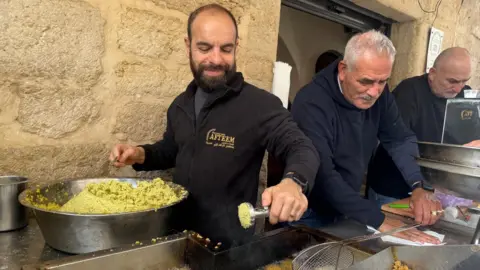
On the edge of Manger Square, a few customers wait to buy hot falafel balls from a row of shops.
“We are preparing for Christmas after one of the most difficult periods we have gone through as Palestinians and Christians,” says Alaa Salama, owner of Aftim, a decades-old family restaurant that has seen its income decline. He says that recently, many families are no longer even able to buy falafel, a cheap traditional snack.
Salama predicted that “Christians will try to celebrate, but according to their situation.” “Whoever wants to take his children to a festival, theater or anything else, does not have the money to spend on this celebration.”
In the cave-like grotto at the base of the Church of the Nativity, a local woman follows a small Indian tour group, crouches next to a silver star marking the spot where Jesus is said to have been born, and lights a candle nearby.
As tensions remain high across the region, people in Bethlehem say they are praying for peace — and hoping tourists will return to the place where Christmas is believed to have started.
https://ichef.bbci.co.uk/news/1024/branded_news/b30b/live/2af36050-d2b2-11f0-9a50-7beb4a0b24cf.jpg
2025-12-06 15:08:00