



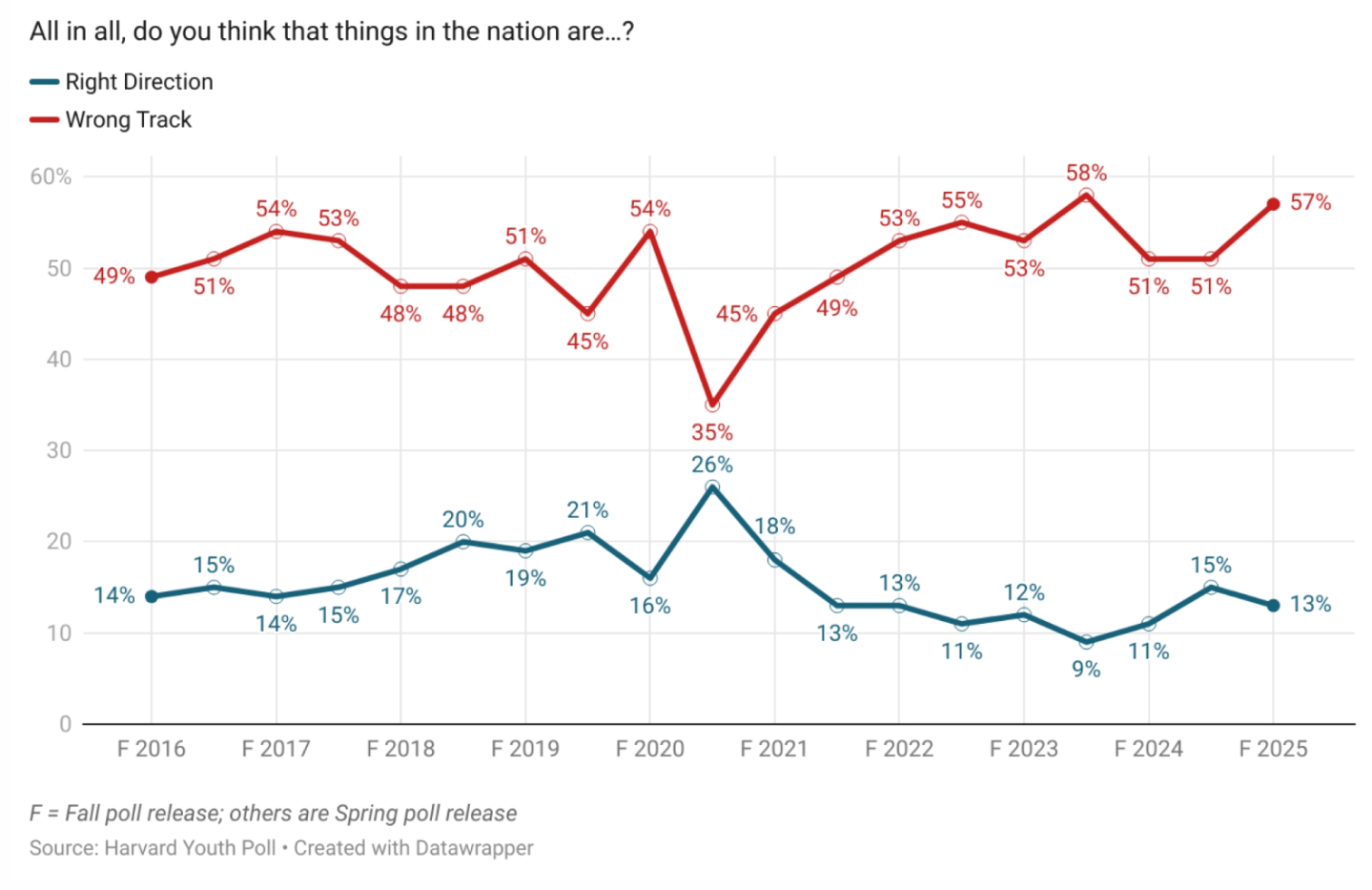
Generation Z has a message for America: We don’t trust you. A long-term poll conducted by the Harvard Kennedy School considered “Gold standard“By many, it presents a worrying finding 51st edition of the Harvard Youth Survey He finds a generation marked by economic insecurity, deep anxiety about the future, and a devastating distrust of the institutions that are supposed to help them thrive. For Generation Z and young millennials, precarity is not a passing phase of early adulthood, but rather the organizing principle of everyday life.
In the fall edition of the poll, young Americans say their lives and futures feel unstable, marked by deep economic anxiety, eroding trust in institutions, and eroding social connections. The survey, which included 2,040 young people, between the ages of 18 and 29, depicts a group that is pessimistic about the country’s direction and skeptical that political leaders or political systems are working in their favor.
Economic anxiety also transcends traditional political and cultural divisions. Pollsters and outside analysts point out that worrying about making ends meet is now a rare unifying experience for young people, whether they live in cities or small towns, or lean left or right. Federal Reserve Chairman Jerome Powell acknowledged the economic struggles of young people, Saying in September “Children graduating from college, young adults, and minorities have difficulty finding jobs.”
Economics, work and artificial intelligence
Economic insecurity is key: many young people worry about making ends meet, affording housing, and finding stable, meaningful work. Added to this economic fragility is the fear that the future of work itself is slipping away from our hands.
Large numbers of young participants view AI as an imminent threat to their long-term job and career prospects, less as a tool. In the survey, concerns about the impact of AI on employment outweighed concerns about immigration and rivaled traditional concerns about trade or regulation.
This perspective represents a stark reversal of the usual generational script. It is often assumed that younger Americans They tend to be early adopters and innately optimistic about new technology, but Harvard’s findings suggest they increasingly associate innovation with instability: unstable schedules, algorithmic layoffs, and work that feels less important. For many, the question is no longer how technology will expand opportunities, but how long it will take before it makes them redundant.
Trust in institutions and politics
The survey shows that this economic and technological uncertainty is fueling a broader collapse of confidence in public life. Trust in government, political parties, and the mainstream media is low, with many young Americans seeing these institutions as a threat to their well-being rather than a source of stability. Even institutions that do relatively better, such as colleges, do so against a background of skepticism that leaders of any kind will act in the best interests of young people.
Trust in major institutions continues to erode, with colleges and immigrants viewed relatively more favorably, while entities such as mainstream media, political parties, and other foundational institutions are often viewed as risks rather than assets. President Trump and both major political parties get poor ratings from young Americans, and although Democrats have an advantage in the 2026 election, that advantage reflects hesitation about alternatives more than genuine enthusiasm.
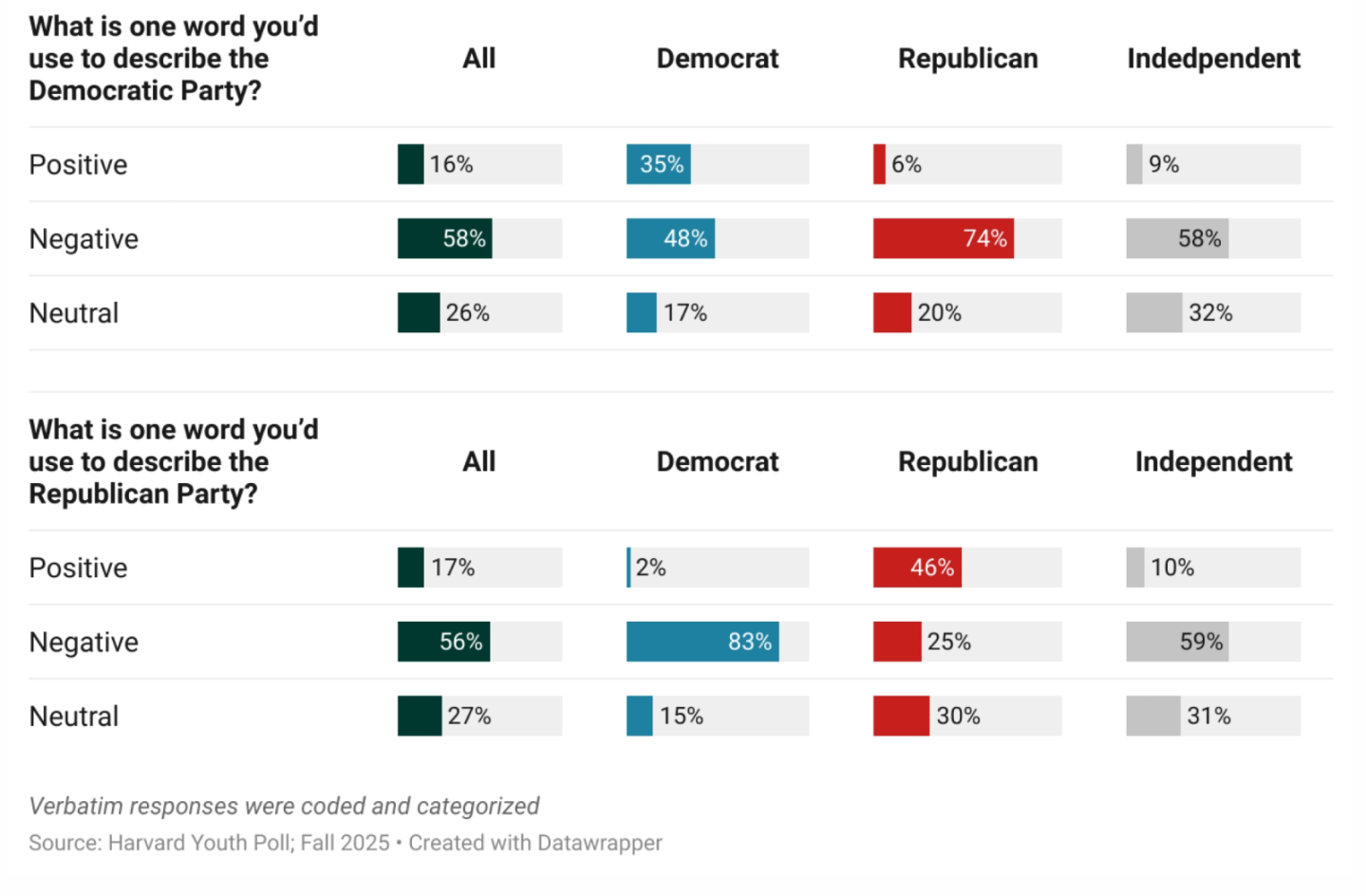
The poll may be biased to the left, as… Harvard crimson I mentioned On how support for the Democratic president is overestimated in the 2020 and 2024 elections. The Harvard Youth Survey uses the Ipsos Knowledge Survey, a poll considered high-quality and probability-indexed, but which has been accumulated over several years and could fail to capture rapidly changing dynamics, such as young males turning to Trump in 2024. However, this edition of the poll shows disaffected young men, regardless of their political affiliations.
Social trust, discourse, and vaccines
Harvard researchers warn that this mistrust extends beyond institutions to the social fabric itself. Many young Americans report that they avoid political conversations for fear of backlash and suspicion that people who disagree with them still want what is best for the country. Social connection is weak: Previous surveys in the same series found that only a small minority feel deeply connected to their communities, and new data suggest these patterns are solidifying rather than declining.
Most young Americans reject political violence, but a non-insignificant minority express a conditional openness to it, which is linked more to financial pressures, institutional distrust, and social alienation than to clear ideological extremism. This large minority says it would be acceptable if the government violated individual rights — a view the report links less to ideology than to financial pressures and alienation. Pollster John Della Volpe has described instability as the thread that runs through almost every reaction, warning that a generation that has grown up through one crisis after another now openly questions whether American democracy and the economy can meet their needs at all.
For this story, luck Journalists have used generative AI as a research tool. An editor verified the accuracy of the information before publication.
https://fortune.com/img-assets/wp-content/uploads/2025/12/GettyImages-2177391108-e1764880442472.jpg?resize=1200,600
2025-12-04 20:48:00