


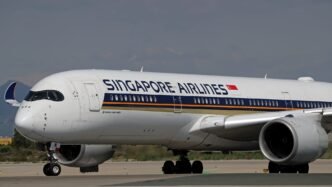

A Singapore Airlines Airbus A350-941 prepares to take off on the runway at Barcelona El Prat Airport in Barcelona, Spain, on May 1, 2024.
norphoto | norphoto | Getty Images
Singapore Airlines shares fell 3% on Friday as analysts warned that continued losses at Air India could impact the group’s profits, following a sharp quarterly profit loss.
Singapore Airlinesalso known as SIA, reported an 82% decline Second quarter earnings Thursday. The company said net profit for the first half of the financial year also fell to S$239 million, down 67.8% from the previous year.
However, the city-state’s national carrier announced that it will pay a special dividend of 10 Singapore cents per share annually over three financial years, amounting to about S$900 million. An interim dividend of 5 Singapore cents per share for the half-year ending September 30 will also be paid on December 23.
Tabitha Fu, an equity research analyst at DBS Bank, told CNBC that SIA’s profitability is likely to remain weak in the near term due to losses linked to Air India, coupled with yield pressures and volatility in the cargo market.

“Given the scale of the restructuring, a meaningful recovery in Air India’s earnings is likely to take some time, impacting SIA’s earnings during FY26-27,” she told CNBC in an email.
Here’s how the carrier performed in the three months ending September compared to LSEG SmartEstiments, which is weighted according to consistently more accurate analyst forecasts:
- Revenue: S$4.89 billion ($3.76 billion) vs. S$4.94 billion expected
- Net profit: S$52 million vs. S$181.47 million expected
Interest income in the second quarter decreased by S$42 million due to interest rate cuts and lower cash balances from dividends and loan repayments. The share of associated companies, including Air India, generated S$295 million during the period.

SIA holds a 25.1% stake in Air India following its November 2024 merger with Vistara, jointly owned by India’s Tata Sons. SIA commenced equity accounting for the airline from December 2024.
“Despite the ongoing challenges, SIA Group remains committed to working with its partner Tata Sons to support Air India’s comprehensive multi-year transformation programme,” the airline said in a statement.
Air India’s losses are expected to continue
Air India also impacted the group’s results In the previous quarter. It was reportedly seeking at least 100 billion rupees ($1.1 billion) in financial aid from SIA and Tata Sons, following the June crash that killed more than 240 passengers. According to Bloomberg.
Any financial support for system upgrades and internal engineering and maintenance capabilities would be proportional to ownership, Bloomberg reported, citing people familiar with the matter.

Lauren Tan, director of equity research at Morningstar, said investors need clarity on the nature of Air India’s losses and whether Singapore Airlines plans to pump more capital into the Indian airline.
“Our main concern — which we hope Singapore Airlines can provide more information about — is whether the losses are due to an increase in the number of aircraft added to the fleet,” she told CNBC. “If the losses are largely related to appreciation and hence depreciation, Air India may be at break-even EBITDA level, and if so, then fine.”
SIA has expanded its business partnerships. It launched new codeshare services with Vietnam Airlines in September, strengthening its presence on Southeast Asian routes.
In October, it deepened its joint venture with the company Lufthansa Group By adding Brussels Airlines, improving routes between Europe and the Asia-Pacific region.
The company said demand for air travel remains resilient heading into the third quarter peak. However, it cautioned that air freight trends remain uncertain amid changing trade policies and market volatility.
“The aviation industry continues to face challenges arising from geopolitical tensions, macroeconomic headwinds, inflationary cost pressures and supply chain constraints,” SIA said.
—CNBC’s Monica Petrelli contributed to this story.
https://image.cnbcfm.com/api/v1/image/107421149-1716977262248-gettyimages-2150851644-urbanandsport-singapor240501_npbek.jpeg?v=1716977311&w=1920&h=1080
2025-11-14 06:11:00