



Vital supplies of US liquefied natural gas are set to start flowing into war-torn Ukraine this winter via a trans-Balkan pipeline.
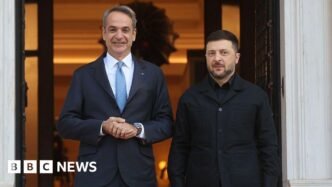
The deal was announced after Ukrainian President Volodymyr Zelensky met Greek Prime Minister Kyriakos Mitsotakis in Athens on Sunday. Mitsotakis recently said that Greece is working to increase the flow of American liquefied natural gas to its terminals “to replace Russian gas in the region.”
The European Commission plans to ban all imports of Russian gas to EU member states by the end of 2027, arguing that proceeds from such sales finance Russia’s war in Ukraine.
Zelensky is currently in France, where President Emmanuel Macron signed a letter of intent to purchase up to 100 Rafale aircraft.
The fighting continued throughout the night, with six people reportedly killed in Russian attacks in the Kharkiv, Kherson and Donetsk regions of Ukraine.
The Russian army said it took control of three other Ukrainian villages, one each in the Kharkiv, Donetsk and Dnipropetrovsk regions.
None of the reports can be independently verified.
Speaking earlier in Athens, Zelensky was quoted as saying that US LNG deliveries would begin in January.
He added, “We rebuild every time the Russians destroy, but this really requires time, great effort and equipment, and with regard to gas… gas imports to compensate for the Russians’ destruction of our production.”
“Greece has become a provider of energy security for your country,” Mitsotakis told the Ukrainian president.
Zelensky said Kiev had set aside money for gas imports from European partners and banks under European Commission guarantees, as well as from Ukrainian banks, to help cover imports through March at a cost of about 2 billion euros (1.8 billion pounds, $2.3 billion), according to Reuters news agency.
Since 2015, when it stopped buying Russian gas directly, Ukraine has been receiving supplies from various EU countries.
The Soviet-era trans-Balkan pipeline connects Ukraine to liquefied natural gas terminals in Greece via Moldova, Romania and Bulgaria.
There were fears of an energy crisis in Ukraine this winter after continued Russian attacks on energy facilities there, especially thermal power plants.
The United Nations Office for the Coordination of Humanitarian Affairs issued an official warning, saying, “The approaching winter poses new risks for Ukrainians… as intensified attacks on power grids undermine efforts to keep homes, schools and health centres” warm.
The letter signed by Zelensky and Macron during their visit to the Villacoublay air base near Paris outlines possible future contracts for Ukraine to acquire Rafale fighter jets “with associated weapons.”
The letter, which does not constitute a purchase and sale contract, also outlines deals for SAMP-T air defense systems, radar systems and drones.
On a visit to Sweden last month, Zelensky signed a letter of intent to purchase between 100 and 150 Gripen fighter jets.
In France, Zelensky also went to Mont Valérin, west of Paris, to visit the nascent headquarters of a planned multinational force that might one day help oversee a ceasefire between Ukraine and Russia.
Tens of thousands of people, most of them soldiers, have been killed or injured, and millions of civilians have fled their homes, since Russian President Vladimir Putin launched his massive invasion of Ukraine in February 2022.
https://ichef.bbci.co.uk/news/1024/branded_news/2c8c/live/37f00010-c39e-11f0-a624-43243f904594.jpg
2025-11-17 12:25:00