


Anbarasan Ethirajan and Tessa WongBBC News

 Getty Images
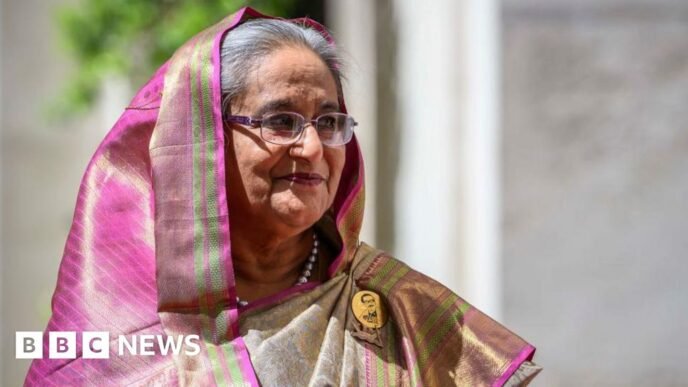
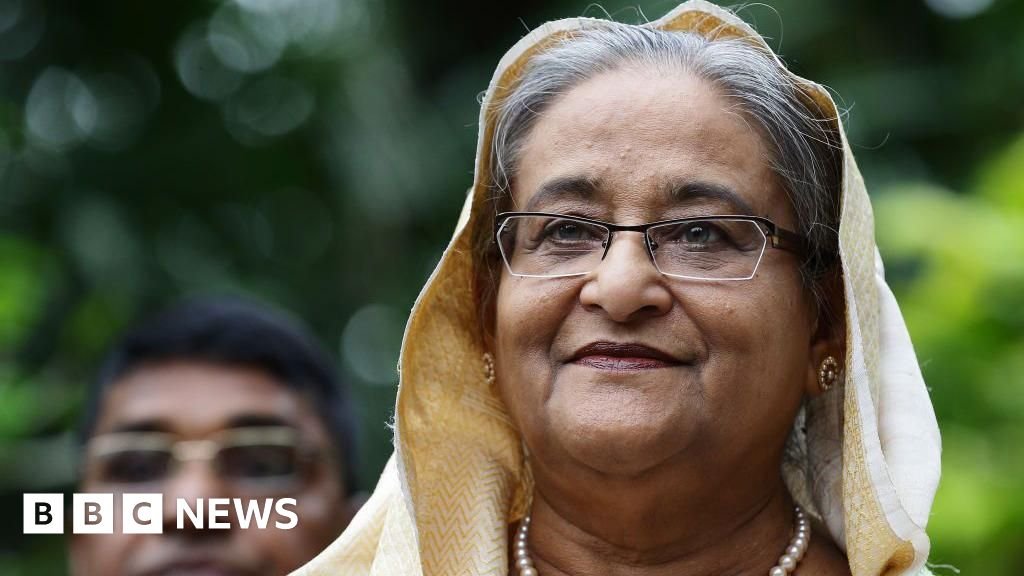
Bangladesh’s longest-serving prime minister, Sheikh Hasina Wajid, began her political career as a pro-democracy icon, but fled massive protests against her rule in August 2024 after 15 years in power.
Since then, Hasina has lived in self-imposed exile in India, where she traveled after she was ousted by a student-led uprising that spiraled into nationwide unrest.
On November 17, a special court in Dhaka sentenced her to death after convicting her of crimes against humanity. It emerged that Hasina had ordered a deadly crackdown on protesters between July 15 and August 5, 2024. She denied all charges against her.
UN human rights investigators said as many as 1,400 people were killed during the weeks of protests that preceded her ouster, most of them by security force fire. Their report found that She and her government have tried to cling to power using systematic and deadly violence Against the demonstrators.
This was the worst bloodshed the country had seen since independence in 1971.
The protests brought an unexpected end to the reign of Hasina, who ruled Bangladesh for more than 20 years.
She and her Awami League party were credited with overseeing economic progress in the South Asian country. But in recent years it has been accused of turning into an authoritarian regime and suppressing any opposition to its rule.
Under her rule, arrests, disappearances, extrajudicial killings, and other politically motivated abuses have increased.
Order “to use lethal weapons”
In January 2024, Hasina won an unprecedented fourth term as prime minister in the elections. It was widely denounced by critics It was considered a hoax and was boycotted by the main opposition.
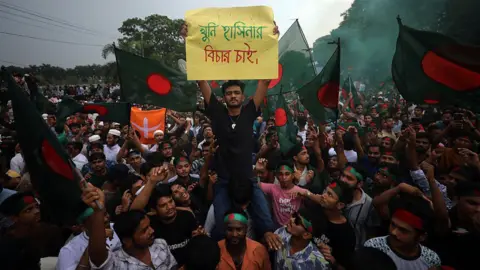
Protests began later that year to demand the abolition of quotas for civil service jobs. By the summer, they had transformed into a broader anti-government movement in which police were used to violently suppress protesters.
Amid increasing calls for her to resign, Hasina remained defiant and condemned the instigators, describing them as “terrorists.” It also threw hundreds of people in prison and brought criminal charges against hundreds more.
A leaked audio clip indicates that she ordered the security forces to do so “Use of lethal weapons” Against the demonstrators. It denies issuing an order to shoot unarmed civilians.
One of the bloodiest scenes The incident occurred on August 5, the day Hasina fled by helicopter before crowds stormed her home in Dhaka. Police killed at least 52 people that day in a crowded neighborhood, making it one of the worst cases of police violence in the country’s history.
Hasina, who was tried in absentia, described the court as a “farce”.
“It is a sham court controlled by my political opponents to issue a guilty verdict in advance… and to divert the world’s attention from the chaos, violence and misrule of the country,” he added. [the new] The government,” she told the BBC the week before her sentencing.
She called for lifting the ban imposed on her party before the elections scheduled for February.
Hasina is also accused of crimes against humanity related to enforced disappearance during the Awami League rule in another case before the same court in Bangladesh. Hasina and the Awami League deny all accusations.
Hasina and other senior members of her former government face trial for corruption in a separate court, charges they deny.
How did Sheikh Hasina come to power?
Hasina was born to a Muslim family in East Bengal in 1947, and politics was in her blood.
Her father was nationalist leader Sheikh Mujibur Rahman, Bangladesh’s “Father of the Nation” who led the country’s independence from Pakistan in 1971 and became its first president.
At that time, Hasina had already gained a reputation as a student leader at Dhaka University.
Her father was assassinated along with most of his family in a military coup in 1975. Only Hasina and her younger sister survived as they were traveling abroad at the time.
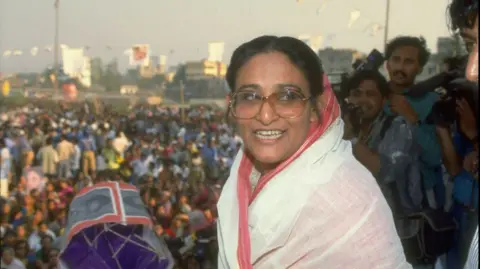
After living in exile in India, Hasina returned to Bangladesh in 1981 and became the leader of the Awami League, the political party to which her father belonged.
It collaborated with other political parties to organize pro-democracy street protests during the military rule of General Hussein Muhammad Ershad. Spurred by the popular uprising, Hasina quickly became a national icon.
 Getty Images
She was first elected to power in 1996. She has been credited with signing a water-sharing agreement with India and a peace agreement with tribal rebels in the country’s southeast.
But at the same time, her government has been criticized for several allegedly corrupt business deals and for being too subservient to India.
She later lost to her former ally-turned-enemy, Begum Khaleda Zia of the Bangladesh Nationalist Party, in 2001.
As heirs to political dynasties, the two women dominated Bangladeshi politics for more than three decades and were known as the “Fighting Begums.” Begum refers to a Muslim woman of high rank.
Observers say their bitter rivalry led to bus bombings, disappearances and extrajudicial killings becoming regular events.
Hasina eventually returned to power in 2009 in elections held under a caretaker government.
A true political survivor, she endured numerous arrests while in opposition, as well as several assassination attempts, including one in 2004 that damaged her reputation. She has also survived efforts to force her into exile and several court cases in which she was accused of corruption.
Achievements and controversies
Bangladesh, once one of the world’s poorest countries, has achieved credible economic success under her leadership since 2009.
Per capita income has tripled in the past decade, and the World Bank estimates that more than 25 million people have been lifted out of poverty in the past 20 years.
Much of this growth has been driven by the apparel industry, which accounts for the vast majority of total exports from Bangladesh, and which has expanded rapidly in recent decades, supplying markets in Europe, North America and Asia.
Using the country’s own money, loans and development aid, Hasina’s government has also implemented massive infrastructure projects, including the groundbreaking $2.9 billion Padma Bridge across the Ganges River.
But Hasina has long been accused of imposing authoritarian, repressive measures against her political opponents, critics and the media – a notable shift for a leader who once fought for multi-party democracy.
Human rights groups estimate that there have been at least 700 cases of enforced disappearance, with hundreds more extrajudicial killings, since Hasina took power again in 2009. Hasina denies her involvement in these cases.
Bangladeshi security forces have also been accused of serious abuses. In 2021, the United States imposed sanctions on its Rapid Action Battalion — a notorious police unit accused of carrying out numerous extrajudicial killings — citing human rights violations.
Human rights activists and journalists also faced increasing attacks, including arrests, surveillance, and harassment.
Hasina’s government has also been accused of “judicially harassing” targets in court cases, including Nobel Peace Prize laureate Muhammad Yunus – who became head of the interim government after Hasina fled. It was He was imprisoned earlier in 2024 He faced more than 100 charges, in cases that his supporters say are politically motivated.
Hasina’s government has categorically denied allegations of such violations. With visits restricted while in power by foreign journalists seeking to investigate the allegations.
The protests against the quota system in the civil service, which sparked last year’s uprising, This came at a time when Bangladesh was struggling with rising costs of living in the wake of the pandemic. Inflation has risen dramatically, the country’s foreign exchange reserves have fallen sharply, and its foreign debt has doubled since 2016.
Critics blamed this on the mismanagement of Hasina’s government, claiming that Bangladesh’s economic progress only helped those close to her.
 Getty Images
https://ichef.bbci.co.uk/news/1024/branded_news/15b1/live/3cf627b0-52e8-11ef-bbe8-4939b38c4f8f.jpg
2025-11-17 10:43:00