




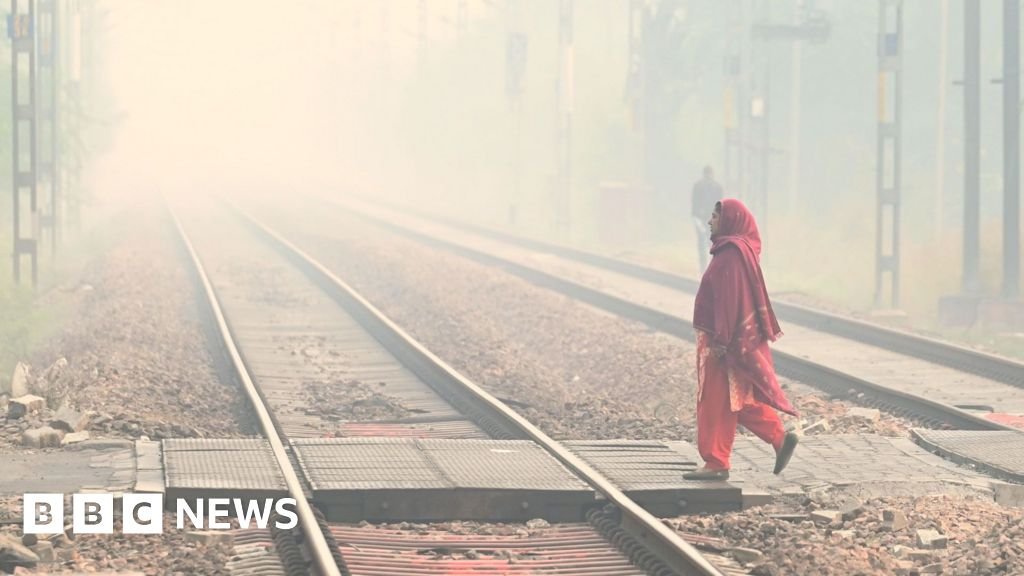
For millions across northern India, the November air tastes grey, the skies look visibly hazy, and even getting out of the house feels like a challenge.
For many, their morning routine starts with checking how bad the air is. But what they see depends entirely on the screen they are using.
Government-backed apps like SAFAR and SAMEER reach 500, the upper limit of India’s AQI (Air Quality Index) scale, which converts complex data on various pollutants like PM2.5, PM10, nitrogen dioxide, sulfur dioxide, carbon monoxide and ozone, into a single number.
But private and international trackers such as IQAir and the open source monitoring platform AQI routinely show much higher numbers, often exceeding 600 and even exceeding 1,000 on some days.
This discrepancy makes people ask the same question every year: Which numbers should they trust? Why hasn’t India officially announced air quality beyond 500 degrees?
India’s official air quality scale shows that readings above 200 degrees pose significant breathing discomfort for most people with prolonged exposure.
Readings above 400 and up to 500 are classified as “severe” and affect healthy people while also seriously affecting those with existing diseases.
However, the scale does not exceed 500 – a maximum that was set more than a decade ago when… The National Air Quality Index was launched.
Why was this threshold introduced?
“It was assumed that the health impact would be the same no matter how high it got because we had already reached the worst,” says Goffran Page, founding director of SAFAR.
He admits that the 500 limit was originally set to avoid causing panic because exceeding this limit indicates an alarming situation that requires immediate relief.
But this approach effectively flattens the data, as anything above 500 is treated the same on official monitors, even if the true concentration is much higher.
“International organizations and portals do not impose such a cap,” Page says. “That’s why we’re seeing the numbers skyrocket on global platforms.”
The BBC has contacted the Indian Pollution Control Board for comment.
Apart from the artificially imposed threshold, there is also a difference in the definition of hazardous air.
For example, WHO guidelines classify levels of PM2.5 – particulate matter smaller than 2.5 micrometres – of more than 15 micrograms per cubic meter in a 24-hour period as hazardous, while the threshold in India is 60 micrograms.
Experts say that globally, there is no universal formula for Al Qaeda in Iraq. The United States, China, and the European Union each apply their own pollution limits.
“The World Health Organization provides the guidelines, and each country has built its own index based on its adaptive capacity, weather and local environment,” says Mr Page. Therefore, comparing India’s base quality index with WHO or US standards may be misleading.
Then there is also a difference in the tools used.
The Indian Pollution Control Board uses Beta Attenuation Monitors (BAMs), which actually measure the mass of particles in the air and are calibrated to strict, standardized scales for each reading.
In contrast, gateways like IQAir rely on sensor-based monitoring devices, says Abhijit Pathak, a scientist who previously worked at the Pollution Control Board of India.
Sensor-based monitors use laser scattering and electrochemical methods to estimate the number of suspended particles in the air.
“Sensors are a different tool and it is not possible to calibrate them for every operation,” says Mr. Pathak, adding that “sensor-based air quality monitoring is not yet approved by the Indian government.”
According to him, India’s air quality framework has not been comprehensively revised since 2009, and he and other environmentalists and activists have called for the metric to be recalibrated based on the latest technologies.
“The National Air Quality Index will need to be revised if we are to include sensor-based data,” says Mr. Pathak.
Removing the cap is also crucial, says Mr Page, “now that most of the available literature has shown that health symptoms continue to worsen with increasing pollution levels.”
Ultimately, India’s AQI does not stop at 500 because pollution stops there. It stops at 500 because the system is built with a roof.
Follow BBC News India on Instagram, youtube, X and Facebook.
https://ichef.bbci.co.uk/news/1024/branded_news/5c3c/live/1a73af60-c17c-11f0-8456-eff94716b162.jpg
2025-11-16 00:00:00