



Catherine da CostaSouthern England
A red British kite emerges from a cage in the remote hills of western Spain and takes flight. At six months old, this is his first taste of freedom.
Without a sound, it rises high into the sky above the bushes and within seconds disappears from sight in a wooded valley in the distance.
It’s the latest installment in a conservation story that has come full circle.
Nearly four decades ago, the birds became extinct in England and Scotland with only a few pairs remaining in Wales.
In the late 1980s and early 1990s, red kite chicks from Spain and Sweden were released into the Chiltern area on the border between Oxfordshire and Buckinghamshire.
It has proven so successful that the species now thrives throughout the UK, with estimates of over 6,000 mating pairs or around 15% of the world’s population.
Dr. Ian Evans, of Natural England, was one of the early pioneers.
“There were a lot of unknowns. The first time we released them, we thought maybe they would die or maybe they would move away,” he said.
“In 1991, we had our first breeding pairs and that was a real surprise because we thought ‘OK, this could work.’
“That was the starting point for establishing other launch sites in England and Scotland.”

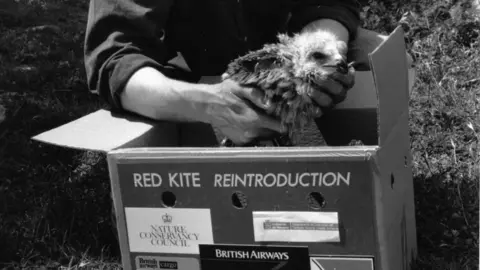 Ian Evans
British-born red kite chicks have now been transported to southwest Spain as part of a four-year project to revive the population there from the brink of extinction.
The area has fewer than 50 breeding pairs due to predators such as the eagle owl and human factors such as illegal poisoning and electrocution.
In 2022, it was conservationists Special licenses granted by Natural England To collect red kite chicks, mostly from Northamptonshire, and send them to the Extremadura region of Spain.
More than 120 chicks have been collected, and about 30 chicks are exported each year.
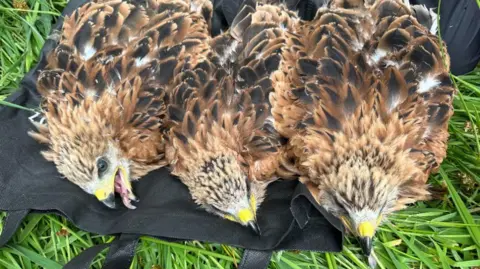 Simon Dudhill
About the red kite
- It is one of the largest birds of prey in Britain, and is known for its reddish-brown body, long wings, forked tail, and distinctive “meow” sounds.
- Once considered a threat to game birds and pets such as cats and dogs, the red kite has been hunted to near extinction in the UK, and at one time there were only a few breeding pairs in mid Wales.
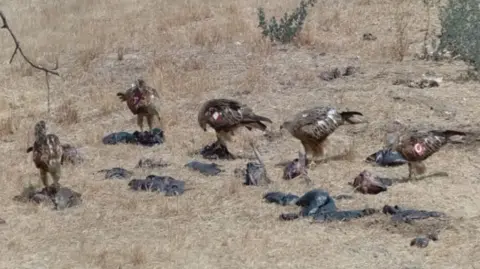
- Red kites are largely scavengers, feeding on carrion and small prey such as rabbits
- These birds breed exclusively in Europe and are threatened with extinction due to illegal persecution through shooting, poisoning and trapping.
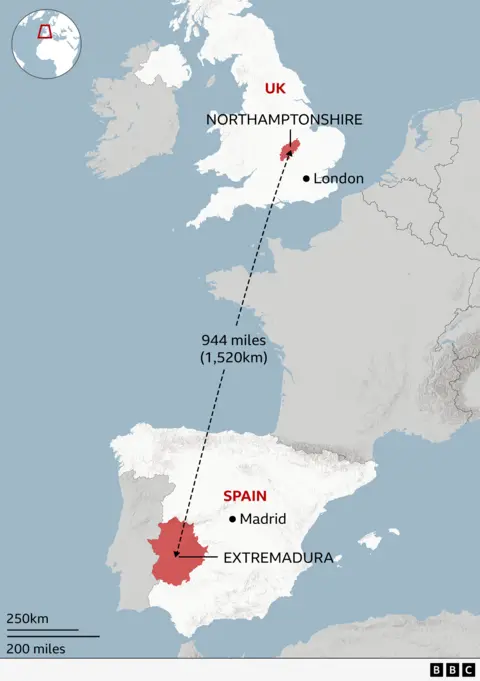
The chicks are flown to Madrid and then transported 240 miles (385 kilometers) south to a wildlife hospital in Villafranca de los Barros, run by the organization Accion por el Mundo Salvaje.Amos).
When I arrived, the small team, led by ornithologist and project manager Alfonso Godino, was hard at work.
Each chick must be weighed, measured and tagged before being fitted with a GPS-enabled backpack, allowing experts to track it.
The birds appear lifeless when they are maneuvered into place. They play dead when they feel threatened, Mr. Godino told me.
When asked if the marking was painful, he said it was a minor inconvenience, like having your ears pierced.
Alfonso says the little ones quickly get used to the large markings needed to watch them from the ground.
The birds are then transferred to cages near the Portuguese border for two weeks to acclimate to their new surroundings.
The release site is quiet and remote. There is a strong stench of rotting flesh emanating from a sheep carcass left to entice red kites to feed here.
When the gate is removed, I half expect the chicks to scramble out, but other than a few flutters inside the cage, nothing happens.
It takes several hours, as if they are building up courage, before one by one they leave the safety of the cage behind them and fly off into the wild.
“A bittersweet moment”
“Now is the exciting moment when they are in the wild, where they can learn to forage, avoid predators, and interact with other species in the area… Thanks to the GPS, we will closely monitor these birds that we have released,” Alfonso told me.
But it’s a nerve-racking time for AMUS field technician Sofia Marrero.
“The mortality rate for birds of prey in general is really high during their first years of life,” she says. “Now it’s a little difficult because you already know that some of them may not reach sexual maturity, so it’s a bittersweet moment.”
In fact, only about a quarter of the red kites flown during the project remain.
The greatest threat comes from predators and natural causes.
In 2023, eagle owls were responsible for killing half of the project’s newly released red kite chicks.
In response, the AMUS team has modified how and when the chicks are released to increase their chances of survival.
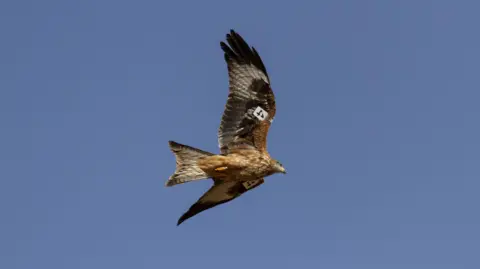 Sebastian Coombes, Amos
Much work has also been done to adapt thousands of kilometers of power cables to reduce the risk of electrocution.
But the greatest danger facing humans to birds of prey is illegal poisoning.
Between 2020 and 2024, 3,060 red kites will be tagged and fitted with GPS as part of the project. Live Eurokite projectcovering 40 project areas in 12 countries.
By September 2024, 1,377 red kites had died, 622 of them from natural causes, including predation, while 195 died from poisoning and 54 from illegal shooting.
Experts say these numbers represent only the “tip of the iceberg” in terms of unlawful persecution.
In the UK, the RSPB is working with European partners to provide advice on how to investigate poisonings.
A report issued by the charity last year revealed that at least 1,344 birds of prey would be killed in the UK between 2009 and 2023.
“The persecution of birds of prey is directly linked to hunting properties, both on lowland pheasants and partridges and in the uplands,” says Mark Thomas, head of investigations at the RSPB.
“All the statistics prove that… two-thirds of all convictions are for gamekeepers, so these people are working legally to control the insects they can control, but on some properties, some gamekeepers are killing the entire protected stuff,” he adds.
The charity believes that licensing gaming properties would address this problem, but this is disputed by the Countryside Alliance.
“Any incident of persecution of birds of prey is absolutely condemnable, with penalties already including prison time along with an unlimited fine,” the non-profit said in a statement.
 Amos
AmosIn Spain, a transport project in Extremadura has seen three mating pairs so far producing two surviving chicks.
As more tagged red kites reach sexual maturity next year, it is hoped these numbers will double.
“There are still vast areas in southern Spain where the red kite was common three decades ago and is now on the verge of extinction,” Godino says.
“So the next step is how we can apply this experience to other regions in Spain.”
https://ichef.bbci.co.uk/news/1024/branded_news/6723/live/8296af90-bd42-11f0-8669-5560f5c90fbe.jpg
2025-11-09 07:38:00