


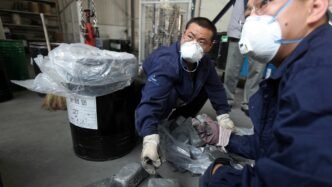

Workers handle neodymium ingots before crushing them at Neo Material Technologies Inc.’s Tianjin Magnequench Plant. In Tianjin, China.
Bloomberg | Bloomberg | Getty Images
US President Donald Trump’s push to secure rare earth supply deals across Asia will eventually weaken China’s dominance in the global supply chain for vital minerals – but analysts said the build-up will take years.
Over the course of ten days, Trump struck deals with Australia, Malaysia, Cambodia, and most recently Japan, to boost supplies of rare earth elements and other critical minerals that are essential for making batteries, cars, defense systems and computing chips.
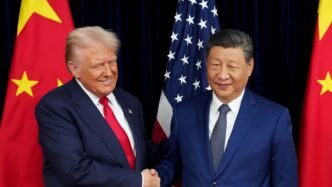
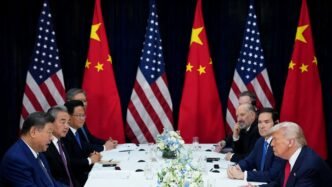
The flurry of deals – part of Washington’s attempt to counter Beijing’s stranglehold on the sector – comes ahead of his meeting with Chinese President Xi Jinping in Busan on Thursday.
The deals “may benefit significantly from being tied together in a multilateral agreement with strong commitments, financing and pooling of resources,” said Wendy Cutler, senior vice president of the Asia Community Policy Institute. It expects more such deals to follow under the Trump administration.
Trump and Xi are expected to address several contentious issues that have stalled long-running trade talks, including Beijing’s rare earth export controls and Washington’s threats of tariffs and technology restrictions.
In the medium term, we will exit the Chinese supply chain, but in the short term, there is still a great deal of dependence on China.
Dennis Wilder
Senior Fellow at Georgetown University
It was Trump’s last victory deal The partnership with Japan aims to secure supplies of raw minerals and bioprocessing while also pledging to finance selected projects over the next six months. Previous agreements with Australia, Malaysia and Thailand He also outlined multi-billion dollar plans, commitments to fair trade practices and avoiding export bans or quotas.
While Trump’s deals would provide much-needed financial support to the industry and may ultimately challenge Beijing’s stranglehold on rare earths, experts say the efforts will be costly and take years to bear fruit.

“What we are trying to do now is get rid of the Chinese as the primary supply chain, but that will take some time,” said Dennis Wilder, a former senior US intelligence official who is now a senior fellow at Georgetown University.
“In the medium term, we will exit the Chinese supply chain, but in the short term, there is still a significant amount of dependence on China,” Wilder stressed.
Goldman Sachs estimates that new rare earth mines tend to take up to a decade to develop, with known reserves of certain “ultra-rare” elements outside Myanmar and China, while refineries would take about 5 years to build.
The bank estimates that China dominates 69% of the rare earth mining market share, 92% of refining, and 98% of magnet manufacturing.
The playing field is level
Brodie Sutherland, CEO of Patriot Critical Minerals, a US-based developer of critical minerals, said these deals are “game-changers” that could reduce US vulnerabilities to Beijing’s export controls, stabilize rare earth prices and accelerate innovative domestic refining and recycling operations.
With guaranteed access to raw materials from friendly countries, U.S. companies can focus on efficient extraction, ethical mining and value-added processing, Sutherland said.
He also cited long-term benefits such as lower risk premiums on financing, allowing rapid establishment of new sites and “leveling the playing field against foreign-backed competitors”.
Mike Rosenberg, professor of strategic management at IESE Business School, said China had allowed rare earth prices to fluctuate in very “strategic” ways to make projects in other countries unprofitable.
Rosenberg added that by using public funds to support these projects, global miners and refiners should be able to make investments that guarantee a reasonable return.
However, efforts to diversify and reproduce production will inevitably lead to negative results Accept some environmental trade-offsThe experts said.
Rosenberg noted that mining and refining rare earth materials in an environmentally friendly way is “very expensive,” while China has kept costs low by limiting environmental controls.
“Consumers may need to accept higher prices for green electronics and technologies that reflect their true physical and environmental cost,” said Patrick Schroeder, senior research fellow at the Center for Environment and Society at Chatham House.
This policy has also led to a further rise in the number of rare earth mining companies listed in the United States this year. Stocks listed in New York MP materials and Metal Trilogy Each of them has increased more than fourfold, Energy fuel Tripled, while Critical minerals It’s up about 90% and rare earths in the USA are up about 75%, according to LSEG data.
Wake-up call
Analysts said it was likely that Trump rushed to sign these deals to gain leverage before his meeting with Xi in Seoul this week.
US officials said earlier this week that they expected China to briefly postpone imposing export controls on critical minerals for a year as part of a broader trade agreement. Cooling rally in mining stocks.

“Beijing’s recent threat of sweeping extraterritorial export restrictions in this sector was a needed wake-up call to partners around the world,” said Cutler of the Asia Community Policy Institute.
Georgetown University’s Wilder said China may have miscalculated on export controls that shook the global economy and expanded the trade war to include other countries, noting that “was not in China’s interest.”
“It was a useful weapon when it targeted the United States, but it becomes less useful when you try to extend that to the rest of the world,” Wilder said. “Because in many ways you bring the rest of the world to the United States.”
https://image.cnbcfm.com/api/v1/image/108219079-1761780358972-gettyimages-104550857-CHINA_RARE_EARTHS_WEAPONS.jpeg?v=1761780375&w=1920&h=1080
2025-10-29 23:27:00